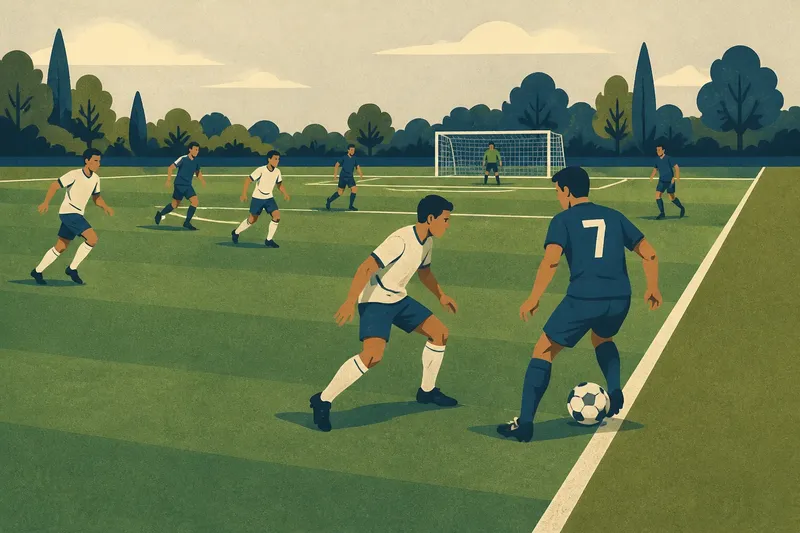
The Myth of the Formation as a Fixed Map
Formation labels describe a starting arrangement, not every position in play. Learn how roles and spacing shift as possession, pressure and support change.
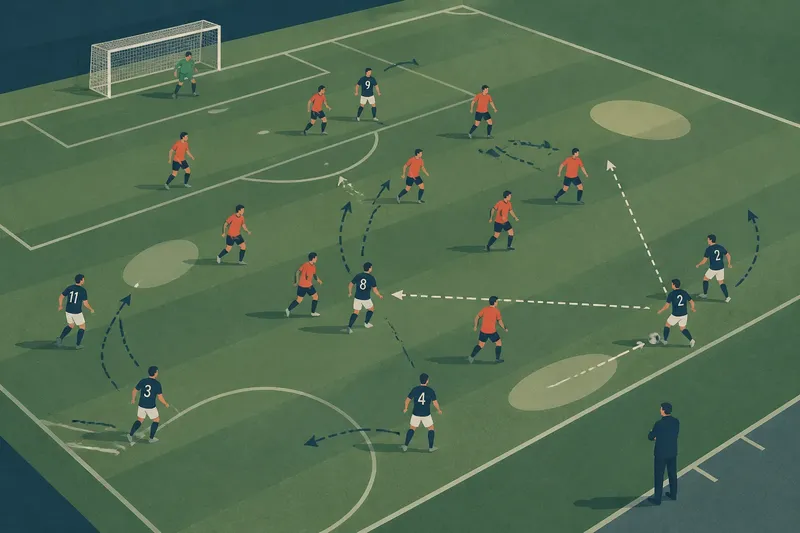
A football formation is a starting arrangement, not a map of where every player stays. Search for “football formation positions” and you will often find tidy rows; during a match, those rows stretch, rotate and sometimes vanish as possession and pressure change.
The label still matters. It gives a concise account of a team’s broad shape and offers a useful starting point for discussing responsibilities. The mistake is treating it as a permanent address for each player. A formation describes a relationship among players at a particular moment, while roles describe what they are trying to do as the situation changes.
What does a formation actually tell you?
A formation such as 4-3-3 or 4-4-2 names the broad distribution of players across lines, usually excluding the goalkeeper. It tells you how many players a team intends to place in its defensive, midfield and forward groups when the shape is recognisable. It does not specify exact distances, movement triggers or the position each player must occupy for the entire match.
That distinction matters because the same label can describe noticeably different plans. In one 4-3-3, a midfielder may advance beside the striker while another holds behind the ball. In another, the wide forwards may retreat close to the midfield line, making the team look more like a compact 4-5-1 without changing its underlying personnel or broad responsibilities.
Formation labels are also snapshots, not full descriptions of a team’s approach. They can help identify a starting structure, but they leave out whether the team is pressing high, defending deep, building patiently or attacking quickly. Those decisions alter the visible shape without necessarily rewriting the team’s basic roles.
Why do positions change when a team has the ball?
Possession creates different jobs from defending. A full-back may move forward to provide width, a central midfielder may drop towards the defenders to offer a passing route, and a winger may move inside to occupy space near the goal. These movements are not necessarily improvisations. They may be planned ways to give the player on the ball options.
Width and depth are useful because defenders cannot cover every route at once. A player near the touchline may stretch the opposing shape; another moving between defenders may give a pass into space behind them. Meanwhile, a teammate staying behind the ball can help the side keep possession if the attack breaks down. The formation’s familiar lines become less visible as these tasks pull players into different zones.
Imagine a team listed as 4-3-3. When its right winger receives the ball near the touchline, the right-back moves beyond them, the nearest midfielder shifts across to support, and the far-side winger moves towards the penalty area. The expected result is a set of nearby passing choices and players arriving in different attacking spaces. The listed formation remains a useful description of the team, but it no longer tells you each player’s current location.
Why does the same team look different without the ball?
Defending usually asks players to protect space and deny useful routes rather than hold their attacking positions. A forward may drop back to help screen a central pass. Wide players may recover towards their own goal, while midfielders narrow the gaps between them. The team may then resemble a different formation from the one shown before kick-off.
Opponents also influence the shape. If they overload one side, defenders may shift across to support one another, leaving the far side temporarily less occupied. If an opposing player receives between midfield and defence, a midfielder may step forward while a defender stays behind to cover. The visible pattern changes because players are responding to threats, not consulting an imaginary set of numbered squares.
A team can press high in one phase and retreat into a compact block in another. The first approach may leave forwards close to the opposing defenders; the second may bring those same forwards nearer their own midfield. Neither movement, by itself, proves that the team has abandoned its formation. It shows that a fixed label cannot record the changing distances required by different defensive tasks.
How do roles differ from positions?
A position is a broad starting location, such as centre-back, central midfielder or winger. A role is the job a player is expected to perform in a particular phase: cover a teammate, offer a forward pass, press an opponent, protect the centre or provide width. One position can involve several roles during a match, and players from different starting positions may temporarily share a task.
This is why a player’s role can be more revealing than a formation number. A midfielder who drops beside the centre-backs may be helping the team begin an attack. A full-back who moves into the middle may be offering a central passing option rather than charging down the flank. The useful question is not only “Where is the player?” but “What does this position allow the team to do?”
Roles are not always interchangeable. A player may be asked to cover a particular opponent or protect an area, and a teammate’s movement can depend on that responsibility being maintained. But the same player can shift between tasks as the ball moves, and the team can adjust its shape without changing personnel.
How can you read a formation as the match unfolds?
Watch the relationships between players rather than trying to assign every player a permanent square. Start with a clear phase: a goal kick, settled possession, a high press or a deep defensive block. Note which players provide width, who stays behind the ball, who moves towards the forward line and how teammates cover the spaces left open.
Then compare the same team across another phase. Does a wide player recover into midfield when defending? Does a full-back advance only after a midfielder has moved across to cover? Does a forward press the centre-back while a teammate closes the nearest passing option? These observations tell you how the team’s shape is made and maintained, rather than merely what label appears beside its name.
It also helps to watch the ball and the far side of the pitch. The nearest group often shifts towards the ball, while players away from it may hold width, prepare to receive a switch or protect against a counter-attack. Looking only at the player in possession can make coordinated movement look like random wandering. The pattern often becomes clearer when you notice who moves in response and who stays in place.
What do formation labels miss?
A label cannot show timing. Two players may occupy similar areas, but one might arrive late to create space while the other stays there to receive a pass. Nor does a number sequence show how quickly a team changes shape after losing the ball, how close its lines remain or which opponent a player is meant to pressure.
Labels can also hide asymmetry. A team may advance one full-back while the other stays deeper, or build through one side while the opposite winger holds a wide position. The formation may look balanced on a lineup graphic even when the match plan deliberately gives each side different work.
Finally, a formation is a team description, not a verdict on individual performance. If a player appears away from the spot a viewer expects, that movement may be part of the plan, a response to an opponent or simply a moment in transition. The position alone does not explain whether the choice was sound; the surrounding responsibilities and available space matter.
Which questions help explain a changing shape?
Does a team change formation whenever a player moves?
No. A single player moving forward or sideways does not necessarily change the team’s underlying structure. Look for a sustained change in how several players share the lines and responsibilities before describing it as a formation change.
Why do commentators give different formation numbers?
They may be describing different phases, such as the team’s shape in possession and its shape while defending. They may also be interpreting a fluid arrangement differently, especially when players rotate or one full-back advances more than the other.
Can one player have more than one role?
Yes. A midfielder might help build from deep, support an attack and then protect the centre after possession is lost. The role depends on the phase and the team’s plan, not just the player’s starting position.
How should a beginner use a formation label?
Use it as a rough description of the initial or settled structure, then watch how players move around the ball and cover one another. Treat the label as a clue about responsibilities, not a claim that every player will stay in one place.
The most useful way to read football formation positions is to treat the listed shape as a starting hypothesis and test it against what players actually do in each phase. Keep track of who creates width, who covers the centre and who moves to support the ball. The answer will usually describe the team more clearly than its formation number does.