Grass or Hard Court: What the Surface Changes
Grass or hard court changes bounce, footing and shot timing. Learn how to read each surface and choose a useful response instead of relying on reputation.
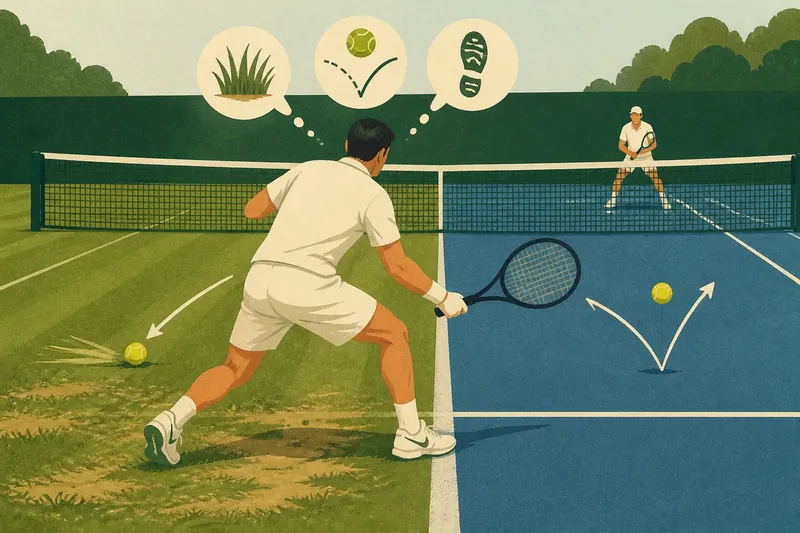
On grass, a ball can skid from one patch and sit up from another; on hard court, its bounce is usually more uniform. Grass or hard court therefore changes a player’s next decision before it changes a rally’s reputation.
The distinction is not simply fast against slow. Construction, maintenance, wear, the ball and the conditions all affect what happens. The useful question is what the surface is doing at the contact point, and how that changes movement and shot choice.
Grass or hard court changes the decisions available
Grass introduces local variation. Blades, soil and worn areas can affect bounce and footing, so a player may have less time to correct a swing or settle into a step. A low or awkward bounce can make a compact response, an earlier contact or a change of direction more practical than a large, carefully timed stroke.
Hard courts tend to provide a more even response across the playing area. That can make timing and contact points easier to repeat, supporting planned patterns and fuller swings. It does not remove tactical pressure: a predictable bounce can help the opponent organise a reply, so placement and the next shot still matter.
Neither surface has a fixed speed. Grass condition, hard-court finish and the ball all contribute; weather and wear can alter the feel further. Treat “quick grass” and “reliable hard court” as starting expectations, not instructions from the court.
Read the bounce before choosing a pattern
Watch where the ball reaches you, how high it rises and whether it skids or changes direction. Then connect that observation to a decision: move earlier if the bounce stays low, allow for a higher contact if it sits up, or change the target if the same placement is giving the opponent an easy reply.
On grass, variation can create trouble for both players. A shot into a worn or awkward area may force a rushed adjustment, but the bounce can also disrupt the hitter’s own recovery. On hard court, a similar placement may be easier to handle, so changing angle, depth or pace can matter more than hoping for a surprise bounce.
Footing belongs in the same read. Notice whether a plant feels secure when stopping or turning, especially on worn grass or a surface affected by conditions. If traction feels uncertain, favour controlled movement and avoid forcing a wide recovery; if footing feels dependable, a sharper change of direction may be available. Court rules and equipment instructions still take precedence where they apply.
Choose movement and contact to suit the ball
A low bounce can make a high, sweeping swing awkward. A shorter preparation, slice, or earlier contact may be more manageable, depending on technique and the ball’s actual height. A more regular bounce can make it easier to choose between driving, lifting and changing direction, but it does not make any one option automatically correct.
Recovery time is part of the choice. If a shot leaves little time to regain balance, a compact swing and a strong first step may be more useful than trying to force a difficult target. A readable bounce can help a player organise, but it can also give the opponent time to do the same. Consider the time left to both players, not just the surface label.
Patterns remain useful on either court, though their reliability differs. On hard court, a player may repeat a sequence of moving an opponent wide and sending the next ball into open space. On grass, a changed bounce or uncertain step can interrupt that sequence. Keep the plan, but be ready to adjust the next contact rather than insisting on the original script.
What do players ask about grass or hard court?
Does grass always make the ball faster?
No. Grass is often associated with a low, quick response, but construction and condition affect the bounce. Watch the ball’s height and travel in the opening exchanges instead of assuming every grass court behaves alike.
Is a hard court always more predictable?
It is generally more uniform than grass, but not perfectly so. Surface finish, conditions and the ball can still affect the response, so use what happens on that court as your guide.
Which surface is easier for a beginner?
That depends on what the player is learning and how the court feels underfoot. A regular bounce may help with timing, while grass may prompt quicker preparation and adjustment; neither is a universal starting point.
How can a player tell what a court is doing?
Notice bounce height, skid or change of direction, and whether stopping and turning feel secure. Use those observations to adjust spacing and shot choice rather than relying on the surface’s reputation.
A worked court read leads to a different next shot
Imagine a player arriving on grass with the expectation that every ball will stay low. In the opening rallies, the ball sits up in one area but skids through in another, and the player’s footing feels less secure on a worn patch. They note the two bounce responses, shorten preparation when receiving the skid, and avoid a sharp turn across the uncertain patch. When the ball sits up, they take the more comfortable contact and direct it away from the opponent rather than forcing a rushed, low-ball response. The result is a clear trade-off: less ambition on the awkward footing, but a shot choice better matched to the ball actually arriving.
For grass or hard court, the useful early read is specific: what the ball did, where the footing felt reliable, and which response that leaves open. Keep observing as play wears on, because a surface can change while its name stays the same.