Reading a New Sport Through Its Scoreboard
Reading a new sport through its scoreboard helps you spot what counts, how scores change and which visible signals mark a shift in play.
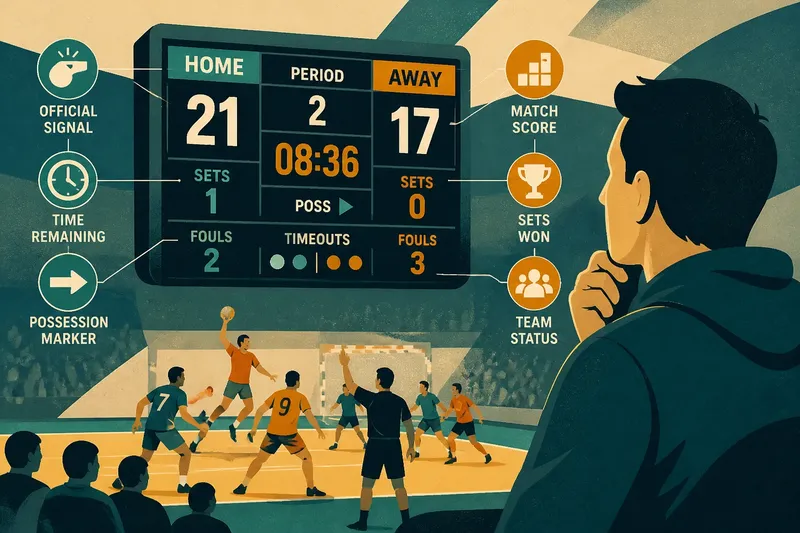
Reading a new sport through its scoreboard is easier if you treat the display as a running account of decisions, not merely a row of numbers. Watch one scoring event from the action that starts it to the moment play resumes, and the sport’s basic grammar often becomes visible.
The useful questions are simple: what counts, how does the score change, and what tells you that the game has moved into a new phase? The answers may be on a screen, a physical board, a referee’s signal or the players’ positions. A scoreboard is often the quickest guide, but it is not always a complete one.
Start by finding what the sport counts
Before tracking who is ahead, work out what earns a change on the board. In some sports, a successful action adds directly to a team’s total. In others, a score is recorded only after an official confirms it, or a sequence of actions earns a point for one side. The score may also show a result that is not a simple count of goals, baskets or runs.
Listen for the language used by officials and commentators. Words such as “point”, “goal”, “try”, “set” or “penalty” can identify different kinds of event. Do not assume that every word means the same thing across sports, or that the larger-looking number represents the total of all successful actions.
Look at the display’s labels. A pair of numbers might represent the teams’ totals, but it could instead show the score within a set, the number of sets won, or a current period’s tally. Team names, abbreviations, colour coding and headings can help distinguish these layers. If the labels are absent, compare the display with what the official announces after an event.
Separate the match score from its smaller units
Many sports organise play into nested units. A match may contain periods, innings, sets, games, rounds or ends. Each unit can have its own score, and the scoreboard may display several at once. A team can lead in the current set while trailing in the match, just as a player can win a game without having won the set.
Try reading the display from the outside in. First identify the match-level result: which side has won more of the units that decide the contest? Then note the active unit and its score. Finally, check whether the display includes a smaller count that belongs to the current exchange, such as a serving order, penalty count or attempt total.
This distinction matters because a number can change without changing the match leader. If a player wins a point inside a game, the match-level tally may remain as it was. If a side wins a set, the larger contest may move closer to a result. The scoreboard’s layout often signals this hierarchy through separate rows or columns, though the arrangement varies by sport.
Watch how the score changes after an event
A scoring event tells you more than what the sport rewards. It can reveal who had possession or control, when the official considers an action complete, and which side begins the next phase. Watch the event, the official’s signal, the display and the restart in that order. This makes it easier to tell a confirmed score from an attempt that looked promising but did not count.
Notice whether the scoreboard updates immediately or only when a unit ends. A display that changes after every point offers a close record of the current exchange. One that changes at the end of a period may be summarising a sequence rather than recording each action. In sports with penalties or reviews, a visible score can also be provisional while officials resolve what happened.
Say you are watching an unfamiliar racket sport and the board shows a score within a game alongside a separate tally of games. You see one player win a rally, but only the smaller display changes. The likely reading is that the rally decided a point, while the larger tally records completed games; watching the next serve can help confirm that the same game continues.
Read the markers that show a phase of play
The scoreboard often has companions. A clock, period label, possession indicator, serving marker, down-and-distance display, or coloured light can tell you what kind of action is currently possible. These markers answer a different question from the score: not “who has more?”, but “what happens next?”
- Period or round label: shows which segment of the contest is under way and whether the display has reset for it.
- Clock: indicates how much of a timed phase remains, though some sports stop the clock or use a count-up display.
- Possession or service marker: identifies which side is entitled to start or continue the next sequence.
- Attempt or penalty indicator: shows a limit or consequence that can shape the next decision.
- Timeout or substitution signal: marks an interruption in which teams may change personnel or tactics.
Do not treat any marker as self-explanatory. A clock may count down to the end of a period, a shot deadline or a break in play. A small arrow may identify possession, direction of attack, or the next side to serve. Match the symbol to what players and officials do when it changes.
Use the official’s signals to interpret the display
An official’s gesture can explain why the scoreboard changed, or why it did not. A raised arm may signal a score, a restart, a penalty or the end of a sequence, depending on the sport. Listen for the call and watch the players’ response: do they return to positions, prepare to restart, or wait for a decision?
When a score is disputed, separate the visible action from the ruling. A ball may appear to cross a line, for example, while an official’s signal indicates that play was stopped earlier. The scoreboard records the ruling in force, not necessarily the moment that first caught your eye. If a review is announced, wait for the official decision before treating the displayed total as settled.
Where the right reading depends on a sport’s official signals, equipment display or local competition format, check the relevant rulebook or organiser’s explanation; the same visual cue can have different meanings.
What should you look for on an unfamiliar scoreboard?
Which number tells me who is leading?
Find the match-level tally rather than assuming the most prominent number is decisive. If the display has several rows, look for labels such as sets, periods or games, then compare the units that determine the contest.
Why did the score change by an unexpected amount?
The sport may award different values for different actions, or the number may belong to a smaller unit rather than the match total. Watch the official’s signal and check which row changed to identify what was recorded.
What does a clock beside the score mean?
It may track time remaining in a period, a possession limit, or elapsed time. Observe whether it stops during interruptions and whether players react to it as a deadline or simply as a period marker.
How can I tell whether play has restarted?
Look for the official’s signal and the action that follows, such as a serve, face-off, throw-in or kick-off. A score change alone does not tell you whether the next sequence has begun.
Build a reliable reading from one complete sequence
Choose a stretch of play that includes an attempt, the official decision and the restart. Keep your attention on three things: what event the sport rewards, which part of the display changes, and what marker or signal determines the next action. Then follow the next sequence and see whether the same pattern holds.
If a scoreboard is hard to read, use the public-address announcement, a broadcast graphic or the competition’s programme to identify its labels. A broadcast may add useful explanations, but it can also show a simplified score rather than every detail visible in the venue. Treat either display as a clue and verify its meaning against the action.
Once you can distinguish the match result from the current phase, the sport becomes easier to follow without memorising every rule. Reading a new sport through its scoreboard is less about decoding numbers in isolation than connecting each change to an event, an official decision and a clear next action. The best moment to check your interpretation is the restart: players reveal, through what they do next, which part of the game the score has just moved.